How a Domain With No Website Outranked Amazon
BGProtect investigates how shiabank.com and bybanking.com returned random DNS answers across millions of subdomains and how one of them climbed to #31 in the world rankings.
10-minute read
Imagine arriving in New York for a Broadway show. You know the theater’s name, but not its address, so you ask your taxi driver. After a quick check in his reference book, he claims he found the theater’s address and starts driving toward it. Five seconds later, the taxi stops, and the driver changes his mind, claiming it’s a different address. Then he changes it again. Other drivers consult the same book and repeat those contradictory addresses, even when they point somewhere that makes no sense.
What if the problem isn’t the people giving you directions, but the source they’re all getting their information from?
That question sits at the center of BGProtect’s investigation of two suspicious domains. Throughout much of 2026, DNS queries for generated subdomains of shiabank.com and bybanking.com returned rapidly changing answers. This phenomenon is strongly suspected of abusing thousands of legitimate DNS resolvers worldwide by using them to pollute passive DNS (PDNS) datasets.
The operational purpose behind this campaign remains unknown.
1. Who Gives the Internet Directions?
The Domain Name System (DNS) translates domain names into IP addresses and other records (such as MX, NS, and TXT). When a user queries a domain, a recursive DNS resolver checks its cache; if the record is not cached, it queries the domain’s authoritative nameserver and returns the answer. In our analogy, resolvers are the taxi drivers, and authoritative nameservers are their reference books. Because resolvers trust authoritative answers without verifying whether the returned IP actually hosts the domain, an actor controlling an Authoritative Name Server can distribute fabricated resolutions through legitimate resolvers worldwide and potentially injecting noise into passive-DNS (PDNS) datasets.
That is what made queries for these two domains so unusual. Queries for fake subdomains returned rapidly changing A, AAAA, MX, NS, and TXT records. Many of these resolved IP addresses belonged to private, multicast, or other reserved address ranges. Publicly routable answers also appeared across many unrelated networks, including:
- U.S. Department of Defense (AS749)
- Amazon (AS16509)
- China Telecom (AS4134)
- and AT&T (AS7018)
None of these random IP addresses actually host these domains or subdomains, and needless to say, URL attempts (HTTP/HTTPS) to each of these domains did not return a webpage or online service.
There was also a distinctive caching behavior. The SOA records of these domains carried a 5-second time-to-live (TTL).
Our research suggests an automated campaign sending queries for generated subdomains to DNS resolvers. The illustration below depicts how the shared authoritative server’s changing answers could have entered passive DNS datasets.
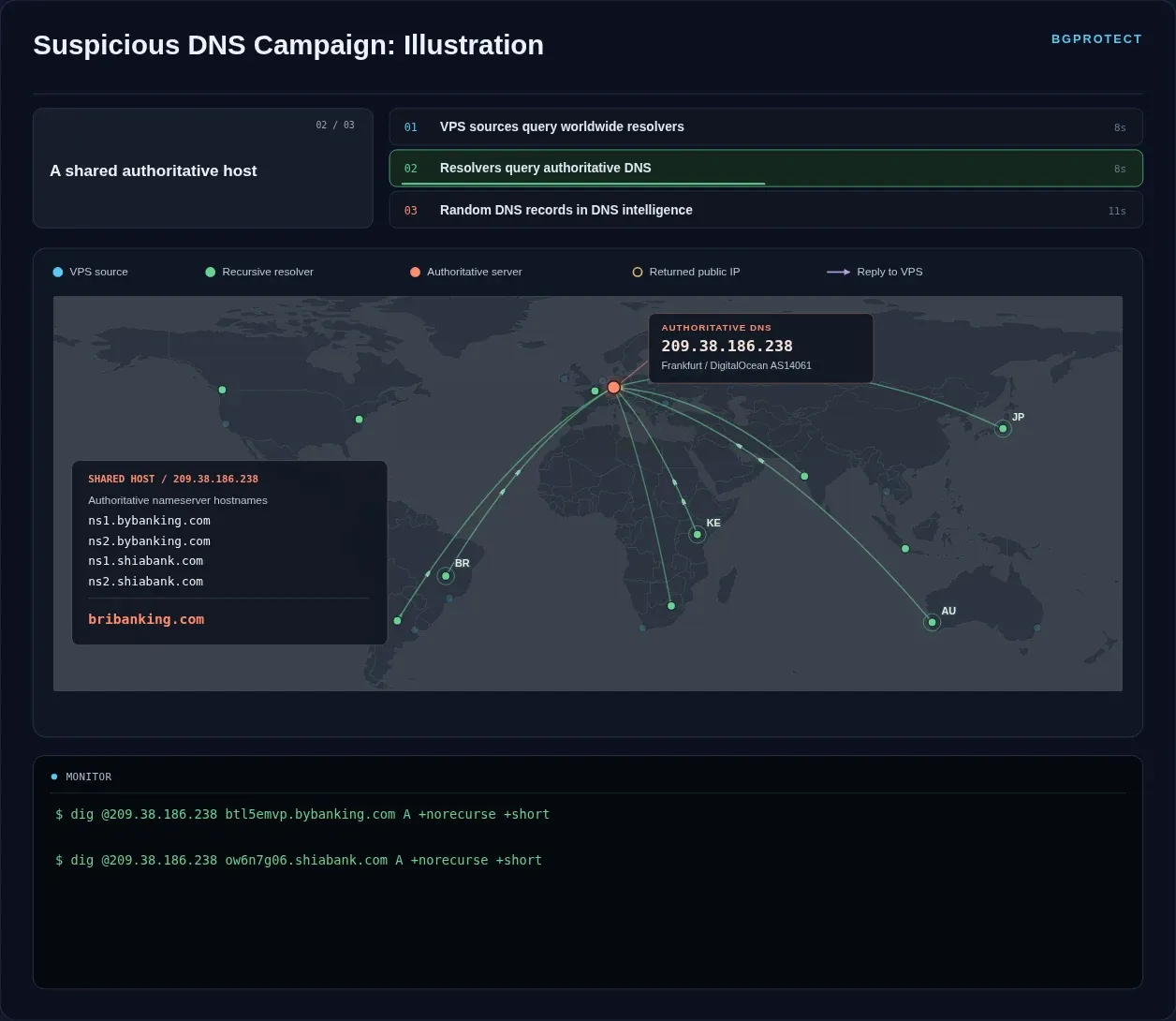
Our resolution analysis traced the recursive path resolvers followed for these generated subdomains to four authoritative nameserver hostnames:
- ns1.shiabank.com
- ns2.shiabank.com
- ns1.bybanking.com
- ns2.bybanking.com
All four authoritative nameserver hostnames resolved to the same DigitalOcean (AS14061) IP address in Frankfurt, Germany: 209.38.186.238. Coincidence or not, another domain with a distinct banking name, bribanking.com, is mapped to that same IP address.
2. Investigating a Worldwide DNS Phenomenon
DNSGuard: Reproducing the behavior
BGProtect DNSGuard monitoring system was used to periodically query shiabank.com, bybanking.com, and bribanking.com, using more than 200,000 resolvers.
DNSGuard provided an immediate confirmation of this suspicious DNS phenomenon: The system identified thousands of DNS resolvers that frequently change their mapping IP address to shiabank.com and bybanking.com. After a few days of monitoring, DNSGuard accumulated more than 1,000 different IP addresses distributed across more than 500 ASNs. This while excluding the fact that most of these resolutions mapped these domains to private/multicast/reserved IP ranges.
Where did the random DNS answers point?
BGProtect DNSGuard measurements of distinct returned IPs across selected categories.
Countries classify the returned IP addresses. The chart includes an unassigned category.
Tranco: An unusually prominent pair of domains
shiabank.com and bybanking.com also appeared with extraordinarily high rankings in Tranco, an internet-popularity ranking using several sources, including DNS-based signals. Their unusually high rankings (within the top 4,000 since July 2026) create the misleading impression that these domains attract traffic comparable to well-known, high-volume websites. The full ranking timeline holds a final surprise.
Cloudflare Radar: A clue to the DNS campaign origins
Cloudflare Radar captures domain queries that directly or indirectly (via DNS Forwarding) queried 1.1.1.1. Some of this data is publicly visible via Radar’s API, allowing us to evaluate the origin of these queries to 1.1.1.1 (by country and ASN, separately). ASN analysis of this data shows an interesting pattern: the majority of these ASNs are hosting networks, including:
- Amazon AWS (AS16509)
- UNMANAGED LTD (AS47890)
- Datacamp (AS212238)
- M247 (AS9009)
This strongly supports that this suspicious DNS campaign was indeed executed using VPS machines hosted on these hosting networks: dozens of worldwide VPS sources that repeatedly generate these fake subdomain queries explain the high Tranco ranking of these domains.
FRnOG: Independent confirmation of the scale
An independent operator had noticed the phenomenon months earlier. In a June 2026 FRnOG discussion, a network engineer reported that he identified VPS machines responsible for generating an extremely large volume of domain queries.
According to his report, all these answers resolved these subdomains into unrelated networks, including active and unallocated addresses.
How large? Roughly 246 million distinct fully qualified domain names for shiabank.com and 187 million for bybanking.com: more than 433 million names in total. As a comparison, the domain queries’ volume this operator reported capturing for amazonaws.com is less than a quarter! (83 million).
3. The End of the Campaign? (Due to Domain Expiration)
The registration records for both domains listed the same expiration timestamp: October 8, 2026, at 20:54:46 UTC. Shortly after those domains’ expiration, DNSGuard observed the rapidly changing answers for shiabank.com and bybanking.com gradually converge on two constant IP addresses:
- 104.219.250.37, announced by Namecheap (AS22612, United States)
- and 2.59.170.20, announced by WorldStream (AS49981, Netherlands)
Later observations showed new authoritative DNS servers under lander.d.parity.domains rather than the previous domain-specific authoritative DNS servers.
The change was not simultaneously visible at every resolver, and it took several hours for this change to be advertised worldwide. Around 16:00 UTC on October 9, that shift had become predominant.
From random DNS mappings to two recurring addresses
4. What Was the Operation Trying to Achieve?
There are a number of possible explanations for this suspicious DNS campaign.
Deliberate intelligence-data pollution is one possibility: countless random DNS records could complicate infrastructure investigations and lead analysts toward unrelated organizations. The same machinery might also be used to test or fingerprint DNS resolvers and security collectors, observing which systems answer, cache, enrich, or follow unusual records.
Another possibility is traffic amplification or resource consumption, with automated security products inadvertently generating further lookups. Finally, the DNS noise may have been a byproduct of another operation, or a deliberate cover for activity that the investigators have not yet identified.
A research or measurement experiment cannot be ruled out either.
In 2024, Infoblox documented Secshow, an internet-scale DNS probing operation whose randomized answers and interactions with security tooling contributed to misleading passive-DNS resolutions and amplified activity. It demonstrates that these side effects are possible.
An additional GHOST STADIUM report, published by CrimsonVector.com in June 2026, linked bybanking.com to a large FIFA phishing campaign called GHOST STADIUM. According to this report, bybanking.com subdomains were used as some sort of “DNS control” to help malicious operators connect their GHOST STADIUM environment.
That phishing campaign affected thousands of football fans worldwide who tried to find fair-price match tickets for the FIFA 2026 World Cup tournament.
5. The Rankings Kept Climbing
Surprisingly, despite the apparent termination of the generative DNS behavior, both domains’ rankings continue to increase in the next monthly Tranco snapshot.
On October 1, 2026, shiabank.com ranked #203 and bybanking.com ranked #2,005. By November 1, they climbed to #31 and #211, respectively. In the November snapshot, shiabank.com stood one place ahead of amazon.com (#32)!
The comparison becomes even more surprising when we examine the other major services: shiabank.com also outranked GitHub (#34), Wikipedia (#38), Netflix (#43), and PayPal (#175). Meanwhile, bybanking.com (#211) moved ahead of bbc.com (#216).
Just two months earlier, on September 1, 2026, shiabank.com had ranked #402, while bybanking.com ranked #2,638.
This continuous increase may suggest that, even though queries for shiabank.com or bybanking.com no longer return random answers, some VPS sources may still generate these fake subdomain queries. In other words, the domains’ expiration stopped the campaign, but the remote DNS lookup process is still alive.
Therefore, this story is not fully closed, and we will continue monitoring this unusual DNS phenomenon.
Monthly Tranco ranking
First-of-month snapshots. A smaller rank is better
Comparison with well-known domains
- microsoft.com #6
- apple.com #9
- amazon.com #26
- github.com #29
- wikipedia.org #31
- netflix.com #40
- paypal.com #166
- bbc.com #212
- shiabank.com #402
- bybanking.com #2,638
The taxi story has a troubling ending: all these wrong directions can remain in the reference books long after the reference book stops changing.
For the complete technical investigation, supporting measurements, and associated infrastructure findings, contact BGProtect.